Showing posts with label design. Show all posts

Thursday, August 17, 2017

Flora, Fauna, and Free Patterns to Come!


A couple of weeks ago, I (Kara) wrote about the inspiration of nature that I see on my daily walks with the dogs here in Germany. (You can read about that here). What inspires me most is the abundance of wildflowers and insects present along the trails. As I see each one, my mind begins to think, "How could this be stitched?" 


 I have been itching to actually stitch some of what I've seen, and now that my fabric is here, I can! But what we think would be fun is to stitch these images from nature together! Would you like to stitch along with us?


The vision for this project is to re-create all this natural beauty in a series of small, relatively simple designs, that can be finished easily without a lot of fuss and offer them free to our readers for a limited time. Each month a new, small design will come out for you to stitch—suitable for appliqué, wool appliqué, or embroidery—whatever you choose! I will show you what I have done and what materials and stitches were used for that particular block, and any tips or tricks I encountered as it was stitched. Since these will be small, scraps of fabric or wool can easily be used, and if you have some threads that you have been wanting to use, this might be just the project for them. I've laid out some of the possible choices for the first block just to give you a hint as to which block will be first!

Some of the potential fabric and thread choicesfor the first block.
What could it be?

Each design will be done as a 6" finished block, but what will the end result be you might ask? That will remain a mystery for a time, but rest assured, there is a delightful finish planned! If you have a different vision for the blocks, that would be great, too—and we would love to see it. This project is all about flexibility, simplicity, and stitching fun. Our hope is that you will join us in this stitching adventure and share your blocks with everyone as you stitch along. 

Come back next week to get your first free pattern and see the first finished block!


Thursday, June 16, 2016

Native Alaskan Inspiration...and a few more quilt shops

If you ever have the opportunity to visit Anchorage, Alaska, be sure to visit the Anchorage Museum. It is not only an incredibly informative museum with an entire hands-on learning lab for children (young and old alike), but it is also filled with inspiration for stitchers. I (Teri) would like to share a few of the pieces of Native Alaskan items that screamed appliqué inspiration to me. Enjoy!

This traditional apron from Eastern Siberia was worn by men and women; it is heavily beaded and trimmed with fur.
How fun would this be to embroider?

I love the appliqué and embroidered design on this hunting bag from the Alutiiq people of southwestern Alaska.

The simplicity of the embroidery design adds to the beauty of the sewing bag, also from the Alutiiq people. It is made from bleached seal throats and painted skin, and it is embroidered with caribou hair. 

This sewing pouch was also embroidered with caribou hair, but was from the Unangax people, also from southern Alaska.

These beautifully beaded mittens are made from moose skin; they are from the Athabascan people, traditionally from Interior Alaska. The mittens often were beaded with leaf and flower designs. 

This Athabascan baby belt was used to support babies held on their mother's or sister's back.
What a beautiful appliquéd border design this would be on a quilt!

A wealthy Athabascan man might dress his sled dog in one of these elaborately embroidered and beaded blankets.

This beautifully beaded octopus bag, named for its eight dangling arms, is from the Tligit people, of the southeastern panhandle of Alaska.

This dance tunic has the Killer Whale crest design, also of Tlingit origin.
I am not sure how this was made, but the design it certainly striking.

This Haida dance tunic has a Bear crest: red wool appliquéd on black, outlined with shell buttons. 

Red wool hunting bag with beaded designs, also of the Haida people from southeastern Alaska.

There is a story of a halibut depicted on this Tsimshian button robe.

Sculpins are represented on these dance leggings, appliquéd and beaded; the tails rested on the top of the dancer's moccasins.

Inspiration is everywhere! I was completely enthralled by the beauty in the stitching of these artifacts, with such intricate designs and needlework. To think that in the midst of surviving such harsh conditions, time was taken to create such lovely patterns and pictures with their needles—both on ceremonial and everyday items. It does support the importance that such artistry has in our lives, doesn't it?

And with all that inspiration, what's a girl to do but visit more quilt shops?! I found three more in Anchorage. At first I wondered how one city could have so many quilt shops, but it was easy to see that each shop had its own unique flavor and offerings. I could be in deep financial trouble if I lived so close to all these shops. There was so much to tempt me, and so little room left in my suitcases!

First, we found the shop that had the booth at the market that I wrote about last week in At Home in a Quilt Shop. Seams Like Home had a bit of everything—machines, quilt fabric, classes, yarn, ribbon, silk, and friendly staff!

Welcome
Yarn! And ribbon and embroidery threads.

Less than half of the store's fabric selection—an impressive inventory. 

The next stop was The Quilt Zone. The minute I walked in, I was drawn to the corner of beautiful Japanese taupes. The store was filled with lovely selections of modern brights, as well as reproduction fabrics. The owner is a designer, and her stunning work hangs throughout the shop. 


From neutrals to brights, her quilt designs are impressive and fun to study, as is her fabric selection.


Our final stop for the day was The Quilt Tree and Yarn Branch. I wasn't able to spend as much time here, as it was nearing closing time; but again, what a lot this shop had to offer, as you can probably surmise from its name. 


Top left: a corner filled with yarn and supplies. Top right: buttons galore!
Below: a section of Alaskan-themed fabrics.
A tiny sampling of what is available in this shop. 

Well, that about wraps up my travels to Alaska. I have returned home with so much inspiration and ideas for new projects—and dreams of hopefully returning next summer for another visit to this quilter's paradise! Thanks for coming along for the ride. I hope that you, too, have found something to inspire a few of your stitches.

Thursday, April 21, 2016

Stitching for Sister


When I (Teri) was young—as in the age of bickering with brothers—I always wanted a sister. I remember my mom telling me that women "make their own sisters." I thought that was easy for her to say: she has a sister! But as I've grown older and wiser (like my mom), I have realized the truth of that counsel. In addition to the blessing of my two brothers—with whom I no longer bicker—I have acquired sisters from my school family from my years as a teacher, sisters from my church family, and sisters from my stitching family. But one special sister has gone from being just a sister-in-law to simply being a "sister." To my children, she is their beloved "Aunt Millie." To me, she is my sister.

About ten years ago, when Millie bought her current home, she asked me to make her a table runner for her new dining room set. She told me the colors she wanted, and I set to work, finding a pattern and creating her runner. I chose batiks, which were lovely in the autumn palette she had chosen. Machine quilting is definitely NOT my thing, but I practiced and persevered, figuring this was the perfect size to manage.

A bit of meandering: not my favorite quilting activity

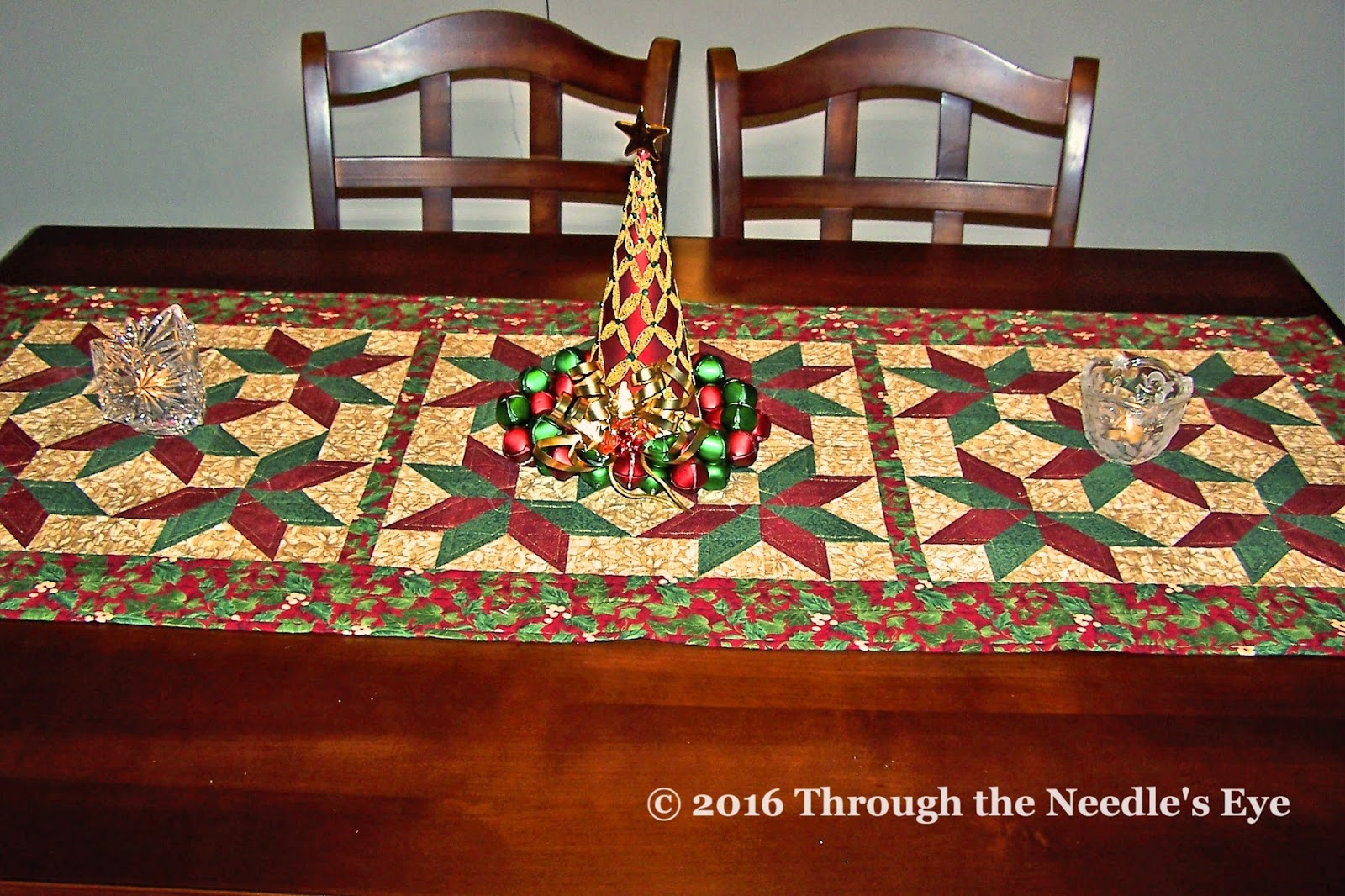
She was so thrilled with that one, she asked if I would make her a Christmas runner, so she could decorate for the holiday. This time, I simply chose a block pattern and used that as the basis for the runner design. I ramped up the quilting a bit, and crazily chose to do some of the quilting with metallic thread. What was I thinking?! But we both loved the effect of the metallic touches on the gold-flecked fabric.

Metallic sparkle in the stars

Free-motion filler in the background


That winter, I took a class in Hampton, Virginia, with Virginia Walton, learning to sew curves. We used gradient hand-dyed fabrics to create curved stars set amidst batik squares. I remember spending a bit too much time in class arranging my stack of 48 batik squares, so that the colors were just right. I never have been able to master "random." I have to carefully work to achieve the random look I want—I call it plandom. Anyway, my husband loved the quilt, so it went to his office. And Millie loved the stars, so I designed a table runner for her. Win, win!

Class quilt on curves: I worked hard to place the warm colors on the diagonal down the middle.

Resulting star design for table runner, and yes—more metallic quilting. Stars need sparkle!


The following summer, I took a class in Hershey, Pennsylvania, on stained-glass quilt designs, with Carol Blevins. The project was a one-block piece, which Millie liked, so I finished it and gave it to her. I then made four more blocks and arranged them to create her "summer runner."


With most of the seasons covered, Millie thought perhaps she should have a wintry design. She chose fabrics that she liked, again batiks, (notice a pattern, here?) and I used Electric Quilt to create the pattern. And now, she had one for each season, and she could change her table runners accordingly. We thought we were finished.


But then I found this line of fabric that screamed at us. We both come from Pennsylvania Dutch (German) roots. The designs in this fabric line tugged on my heart, so I naturally bought yardage, knowing I would find ways to use it. When I showed it to Millie, I knew she would want another runner. And she did, of course! 

We both loved this fabric, so reminiscent of the fraktur and distelfink designs we saw growing up.

Not long ago, I was at her house for lunch, and as we reminisced and I took pictures of her table, she started pointed out colors she liked, just in case I might want to make her another runner . . . 


After all, what are sisters for, anyway? I guess I'd better start designing a new table runner!

Thursday, May 14, 2015

Turning to Him

Turning to Him hangs above the fireplace.
This is the story of a simple guild challenge quilt that became so much more. It hangs over our fireplace, and I (Teri) enjoy looking at it daily, but it is something greater than just the design and the colors, a testing of new skills and old. In fact, for several years, I was sure I could never produce another piece that I thought could "measure up," and a bit of a creative dry spell began. Happily, I've overcome that! This quilt now inspires my creativity.

Challenge fabric, by Robert Kaufman
Several years ago, our local quilt guild was celebrating its 20th anniversary, and for its challenge, we were given a piece of fabric from which to produce a project. I knew of several people who rather disliked the fabric and couldn't imagine making anything of beauty from it. I, however, loved the warm, earthy colors and the ombré effect of the hues. At the time, I was taking an online class to learn how to use my Electric Quilt design program, so it seemed a good time to play with those new skills. Because the fabric had the spirals in its design, I wanted a pattern that reflected that motion. After searching the block library, I found the twisted log cabin block and thought that might work well. I had a great time playing with the designs for the blocks and borders. While paper piecing is not my favorite, these blocks were screaming to be paper pieced for perfect accuracy. The outer border was created using careful measurement and templates. (Proof that we really do use that math we learned in school!)

My favorite part of any quilt process is selecting the colors and fabric for the project. Studying the spirals in the base fabric revealed the four color groups that would move from light to dark, mimicking that ombré look: green, cerulean blue, brown, and gold to red. That last "leg" was my challenge. The first three colors were straightforward, but I had two colors left—a gold and a red. Finding six shades and values for either could be difficult, so I chose to blend those two into one movement, going from cream to gold to red, using a fabric with both gold and red in the middle. The lightest and darkest of that "leg" became the triangles for the outer border. 

Fabric selection: my favorite part!
With my friend Barb, (the same friend who helped me with my grandson's Dr. Suess quilt described in Thing 1 and Thing 2,) I set out for the quilt shops. My stash had provided a few of the fabrics I would need, but we had to visit three shops to complete the job. I can be pretty picky when it comes to color; I had to be sure the greens were the right hues: not too yellow or blue, but just right. In the end, the piles looked like this.

Making this quilt was a joy. I loved seeing the colors come together. Every free moment I had, I found myself in my sewing room, even if it was only to stitch a few seams. I couldn't wait to see this top complete. With each finished section, it did not disappoint; my vision on the computer screen and paper was coming to life in fabric. I was seeing the movement that I had hoped to see, replicating the turning of the spirals in the base fabric. 
Center of quilt, with each block turned a quarter turn.
Lower right hand corner of quilt
When it came time to plan the quilting, my LEAST favorite part of the whole quilt process, I opted to stitch the twisted blocks in the ditch and echo stitch the chevrons in the border. I am not skilled at free motion quilting, but the spirals seemed to need something spiral in their quilting. I decided that the best alternative for the inner border would be to stitch beads in each of the rectangles making up those spirals. And of course, I had to make the colors of the beads and rectangles match. It was surprising to me how calming and enjoyable I found that process to be; it might have actually been the first time that I found hand stitching to be quite comforting! (Odd, as most of my work is now hand work. At that point, however, I far preferred machine work.)
Glass beads hand-stitched in the border fabric, matched to color.
As I stitched, I found myself humming along to the song that seemed to be stuck in my head. (I always have a song running through my brain!) I watched the turning spirals in the fabric surrounded by the turning motion of the twisted log cabins, and the hymn "Turn Your Eyes Upon Jesus" seemed to turn endlessly in my mind. At this time, my oldest son was about to be deployed to Iraq—never an easy thing for a mother. I guess it was gnawing at me a little more than I was acknowledging to myself, for this song just would not let go. The night before he left to go overseas, I was working on the label of the quilt. I realized how anxious I was and knew I could not carry that through the next months of his deployment. I had to trust that my son would be okay. I wrote a poem which I printed on the label for the back of the quilt. The next day when he called me to say he was about to board his plane to head to Iraq, I read the poem to him. He assured me that whatever happened, he would be fine. I found an enormous peace, knowing that God is in control of all things, even if they aren't always easy for us. I am reminded of that truth each time I look at this quilt.  
Quilt label on back


On exhibit in Harrisburg, PA, with my mom
I am happy to say that I entered the quilt in the guild challenge and won first place. It also was accepted at the Mancuso Quilt Show in Harrisburg, Pennsylvania, that fall. I must confess, it was fun to see people studying the quilt in the exhibit. It even got my parents to the quilt show! My son returned from his deployment and is now married and has the grandson who enjoys his Thing 1 and Thing 2 quilt. 

I learned a lot about design and construction while making this quilt. But for me, the reminder I receive from the quilt is priceless: I may be able to control the colors and precision of my quilts, but ultimately, I am not in control. For that, I am thankful.

Cornerstone of the quilt

Black and white filter to determine color value
FUN TIP: Did you know that the black and white filter on your phone camera is a useful tool for assessing the values of your fabrics? It makes it clear which colors are your darks, mediums,  and lights. (I was almost afraid to change one of my photos to black and white, but thankfully my eye wasn't too far off the mark.) When choosing fabrics, I now always use this to double check to make sure the values are what I want them to be. I wish I would have known this trick when I was selecting fabrics for this quilt!